
 Log In

What if your clients could generate the same amount of retirement income using significantly less capital?
Today, it’s possible.
A more efficient retirement income strategy starts with asking a different question: Instead of focusing solely on how much clients need to accumulate, consider how much capital they actually need to generate their desired retirement income.
In these two case studies, we'll go beyond a familiar planning assumption — the 4% rule — to explore a different approach to meeting clients’ retirement income goals.
Rethinking Retirement Income Efficiency
The 4% rule — a withdrawal guideline traditionally used to help retirees make their savings last about 30 years — has faced increasing scrutiny as a one-size-fits-all approach that doesn’t account for modern realities such as longer lifespans and real-world spending habits.
While the 4% rule focuses on portfolio withdrawals, retirement income efficiency takes a broader approach, evaluating how different income sources can work together to maximize sustainable retirement income while managing the risk of outliving one's assets.
Instead of focusing solely on a portfolio's rate of return, retirement income efficiency considers how effectively assets can generate income to support a client's desired retirement lifestyle. Generating more income from a given amount of capital doesn't necessarily mean earning a higher investment return — but it may allow clients to meet their income needs while preserving more assets for other financial objectives.
Advisors who previously ruled out guaranteed-income solutions may have good reason to reconsider them today. Higher interest rates have helped make guaranteed lifetime income payouts more competitive with traditional income-generating strategies, potentially changing the role these solutions can play in retirement income planning. The following case studies illustrate why they're worth another look.
Case Study No. 1: What Income Might a $100,000 Allocation Provide?
Consider a 65-year-old client allocating $100,000 to generate retirement income beginning immediately.
Using a traditional 4% initial withdrawal guideline, the portfolio would provide $4,000 in first-year income. In this hypothetical example, a fixed indexed annuity (FIA) with a guaranteed lifetime income rider and an assumed 7.5% payout rate could provide $7,500 in annual income.
|
Traditional portfolio withdrawal |
FIA with guaranteed lifetime income |
|
|
Initial allocation |
$100,000 |
$100,000 |
|
Withdrawal/payout rate |
4% |
7.5% |
|
Initial annual income |
$4,000 |
$7,500 |
|
Lifetime income guarantee |
No |
Yes, subject to contract terms |
In this example, the FIA provides $3,500 more in initial annual income from the same $100,000 allocation. The comparison illustrates how the two approaches may provide different income levels and guarantees; it does not mean the payout rates are equivalent measures of investment performance.
The FIA’s 7.5% payout rate represents the annual income payable under the rider, not a 7.5% return on investment. Unlike portfolio withdrawals, guaranteed lifetime income payments are designed to continue for life, subject to the annuity contract’s terms and the issuing insurer’s claims-paying ability.
The first example illustrates how different strategies can generate different amounts of income from the same initial allocation. But what if the client has a specific retirement income gap to address?
Case Study No. 2: How Much Capital Could It Take to Cover a $2,000 Monthly Retirement Income Gap?
Consider a 65-year-old client with a retirement income gap of $2,000 per month, or $24,000 per year, beginning immediately.
Using a traditional 4% initial withdrawal guideline, the client would need $600,000 in invested assets to provide $24,000 in first-year income. In this hypothetical example, an FIA with a guaranteed lifetime income rider and an assumed 7.5% payout rate could provide that initial income with a premium of approximately $320,000.
|
Traditional Portfolio Withdrawal |
FIA With Guaranteed Lifetime Income |
|
|
Capital required |
$600,000 |
$320,000 |
|
Withdrawal/payout rate |
4% |
7.5% |
|
Initial monthly income |
$2,000 |
$2,000 |
|
Initial annual income |
$24,000 |
$24,000 |
|
Lifetime income guarantee |
No |
Yes, subject to contract terms |
In this hypothetical example, the FIA requires $280,000 less capital — about 47% less — to provide the same initial annual income. This could allow the client to address a defined income gap while keeping other assets available for investment management, liquidity, growth potential or other financial objectives.
Incorporating guaranteed lifetime income doesn't have to come at the expense of traditional investment management, however.
How Can Guaranteed Income Complement Traditional Retirement Withdrawal Strategies?
A strategy that combines guaranteed lifetime income with traditional portfolio withdrawals can help balance predictable income with the liquidity, growth potential and flexibility of a managed investment portfolio.
For example, allocating a portion of a client's retirement assets to an FIA with a guaranteed lifetime income rider may help establish a dependable income floor to cover essential expenses. With some income needs addressed through contractual guarantees, clients may be less dependent on selling investments or making portfolio withdrawals during market downturns.
This approach can give advisors greater flexibility in managing the remaining portfolio for other client priorities, including discretionary spending, long-term growth and legacy planning.
Of course, guaranteed income solutions involve tradeoffs. Annuities may have liquidity restrictions, surrender charges, rider fees and limitations on inflation protection. Advisors must evaluate these considerations alongside the client's income needs, investment objectives and overall financial circumstances.
What Could More Efficient Retirement Income Planning Mean for RIAs?
When you incorporate guaranteed income into retirement planning to improve client outcomes, the benefits also may extend to your practice.
Using less capital to generate a client's desired retirement income could leave more assets available for investment management and other financial objectives. Incorporating guaranteed income may also help reduce the need for portfolio withdrawals during market downturns, potentially helping preserve invested assets over time.
Helping clients secure predictable lifetime income while maintaining assets for growth, liquidity and legacy goals can strengthen the advisor-client relationship and differentiate your services. Income is closely tied to a client’s sense of security and ability to enjoy retirement. When clients understand how their plan is designed to support their lifestyle, they may feel more confident about the path ahead. Satisfied clients are also more likely to share their experience with family, friends, and colleagues. And that can create opportunities for referrals and deeper relationships.
How Can RIAs Incorporate Insurance Solutions Into Their Practices?
You don't have to become an insurance expert to help clients benefit from guaranteed-income solutions. Whether you're new to insurance or already incorporate it into your practice, SMS Financial Solutions™ offers the expertise, tools and support to help you expand your retirement planning capabilities.
Which of these paths describes you best?
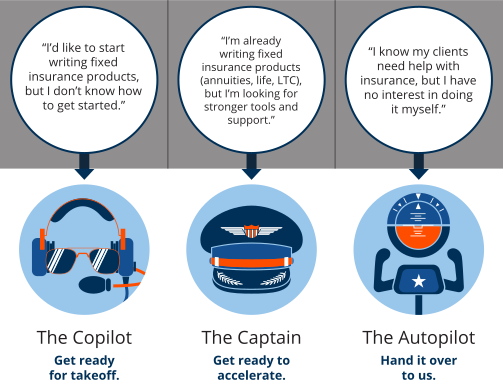
Our flexible approach gives you three ways to incorporate insurance solutions into your practice:
- Copilot: Work alongside our specialists to learn how to incorporate insurance solutions into your clients' financial plans.
- Captain: Take the lead in offering insurance solutions, backed by our product expertise, training and resources.
- Autopilot: Refer clients to insurance specialists who can help address their insurance needs while you focus on investment management or other core services.
The right approach depends on your experience, business model and how involved you want to be in the insurance process.
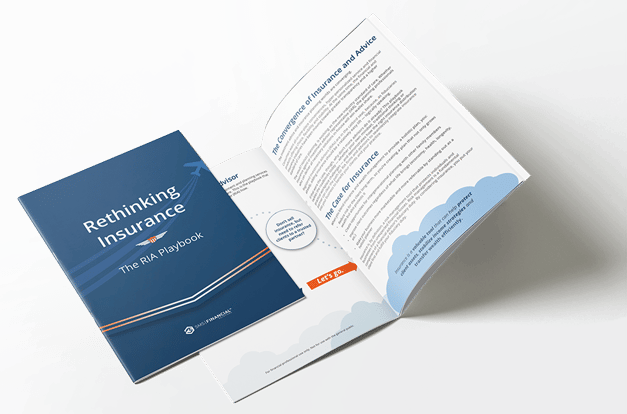 Fill out the form below to download the free RIA Playbook. “Rethinking Insurance: The RIA Playbook” includes case studies from leading RIAs and investment advisor representatives (IARs) who are strengthening retirement income, asset protection and legacy planning with holistic retirement planning.
Ready to Talk About Retirement Income Efficiency?
Whether you have a client in mind or a general question, we’re here to help. Call the SMS Financial Solutions team at 1.877.645.4939.
Share this blog post:


