
 Log In

To find prospects in a niche, define the audience you want to reach, choose geographic and demographic or business criteria that fit your services, then review the matching records before ordering a list.
If you’re thinking of building your practice around a specific niche — whether teachers, dentists or HVAC businesses — you’re probably wondering how to identify prospects within that group.
Today, identifying a niche and reaching prospects within it can be easier than ever, thanks to the combination of artificial intelligence (AI) and targeted consumer and business prospect lists.
Here, we’ll show you how to use AI such as ChatGPT to brainstorm niche ideas and plan your outreach and how to use audience data to find people or businesses in a particular area who match your criteria.
Start by defining the niche
A niche is most useful when it describes an audience you can serve with relevant products and expertise. It may be based on occupation, business type, life stage, location or a combination of characteristics. You might focus on dentists, electricians, teachers nearing retirement, people approaching age 65, recent homeowners or households with specific age and income characteristics.
Before you look for insurance leads, consider what the audience may need, which products you offer and where you can serve them. A clear profile helps you select relevant search criteria and avoid building a list so broad that it gives you little direction. The U.S. Small Business Administration also recommends researching your target market and its characteristics as part of planning and marketing a business.
Use ChatGPT to explore and refine your idea
ChatGPT can be one option for the planning step. You can ask it to help brainstorm niches that fit your experience and mix of offerings, outline common concerns for a group, or suggest questions to learn more about the audience. For example, an advisor considering a focus on teachers could ask for ideas on how to learn about educators’ life-stage needs and what topics might make useful educational content.
AI can also help you draft an initial mailer, email or call outline. Review the output for accuracy, adapt it to your audience and make sure any outreach follows applicable marketing and privacy requirements. AI can help you plan an approach; it does not identify individual local prospects or replace your judgment about whom you can serve.
Build a prospect list around your audience
After defining your niche, decide where you want to reach people and which characteristics matter.
For agents and advisors contracted through Senior Market Sales® (SMS), USADATA is an on-demand resource for building consumer and business prospect lists. Whether you work with annuities or health, life or long-term care insurance, USADATA can help you build more targeted prospect lists based on the characteristics that matter to your business.
USADATA lets agents select a geographic area — such as ZIP codes, a city, county or state, a radius around an address, or an area drawn on a map — and then choose audience criteria. Available filters vary by list type and may include age, household income, net worth, interests, home purchase date, business industry or employee count.
When filtering by industry, don’t guess a code number or name. Use the U.S. Census Bureau’s North American Industry Classification System (NAICS) search to look up industries by keyword or code. A NAICS code is a two- to six-digit hierarchical number used by government agencies and businesses to classify business establishments by their primary economic activity. It replaced the Standard Industrial Classification (SIC) system, which used four-digit codes in 1997, but if you still use SIC codes like some businesses, many lead-generation platforms map or natively support SIC codes so you can still pull targeted prospect lists.
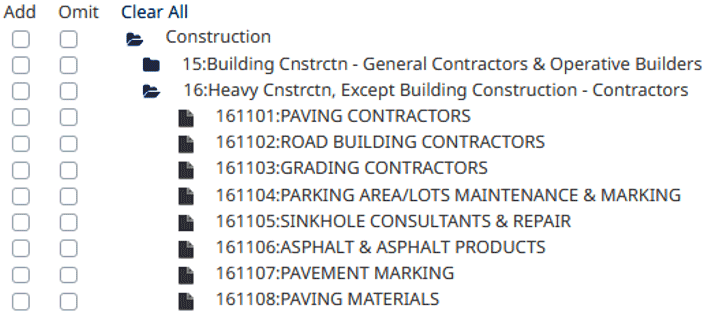
Choosing too broad of an industry category or code can damage your results with low conversion rates, wasting money. For example, choosing “construction” from the USADATA list below would result in a much larger than necessary list if you were targeting road building contractors.
Effective marketing begins with audience definition. As Entrepreneur reports, selling to everyone is becoming less useful every year, and the entrepreneurs who tighten their focus to a tiny group are repeatedly winning, making the “micro-niche” strategy “one of the most reliable paths for building a defensible, profitable business.”
Match prospect criteria to the opportunity
You can filter your niche by the products you offer and match them to the opportunity. For example:
- Health insurance: People approaching age 65 in the areas you serve
- Life insurance: New homeowners or households that fit your chosen profile
- Small-business coverage: Businesses narrowed by industry, business type or employee count
- Annuities or long-term care insurance: Households filtered by age, income or net worth, where those criteria fit your prospecting plan
These are ways to define an audience, not guarantees that each record is a qualified buyer. Choose criteria that connect to a real service you can provide, then review the results before placing an order.
Review the available audience before ordering
USADATA calculates how many records match the geography and criteria you selected. If the count is smaller than you expected, you can broaden the location or adjust the filters. If it’s larger than your budget or campaign requires, you can narrow the criteria or select a smaller number of records.
Think about how you will use the list before ordering. USADATA’s phone records are scrubbed against state and national Do Not Call lists. Scrubbing is one data feature, not a substitute for checking the requirements that apply to your outreach. Review the Federal Trade Commission’s guidance on the Do Not Call Registry and telemarketing rules, and follow your organization’s compliance procedures.
Use USADATA through SMS when you are ready to prospect
USADATA offers on-demand list ordering without a monthly subscription, and special pricing is available through the SMS partnership. To learn more about the platform and its list-building steps, read USADATA’s Marketing Data Platform: Your Path to Strong Prospecting or watch this webinar.
Ready to find your marketing niche prospects?
Create your complimentary MySMS account, then find the USADATA link in the Leads and Marketing section to build a list for your target audience. If you already have an account, log in to MySMS and open the prospecting list resource.

Share this blog post:


