Log In


Long-term care (LTC) planning is often viewed primarily as a health care issue, but for retirees it can also become a significant tax issue. Many families focus on the direct cost of care while overlooking the secondary consequences that occur when retirement accounts are used to pay those expenses. The result can be a costly chain reaction that increases taxes, Medicare premiums and the amount of money that must be withdrawn from retirement savings.
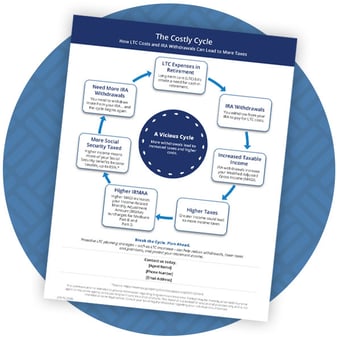
The infographic below illustrates what many financial professionals call the “costly cycle” of long-term care expenses. At first glance, the process appears straightforward: a retiree incurs care costs and uses available assets to pay them. However, when those assets are held in tax-deferred accounts such as traditional IRAs, each withdrawal can create additional taxable income. That extra income can trigger several other financial consequences, creating a loop that becomes increasingly difficult to escape.
LTC Costs Create an Immediate Need for Cash
Many retirees eventually face expenses associated with home health care, assisted living, memory care or nursing home services. These costs can be substantial and often arrive unexpectedly. Even retirees with significant savings may discover that their available cash flow is insufficient to cover ongoing care expenses.
When this happens, many individuals turn to their traditional IRA or other qualified retirement accounts. While these accounts may contain substantial balances, withdrawals are generally treated as taxable income. What begins as a simple effort to pay a care bill can quickly affect a retiree’s broader tax picture.
IRA Withdrawals Increase Taxable Income
Traditional IRA distributions are included in taxable income. As withdrawals increase, Modified Adjusted Gross Income (MAGI) rises as well. MAGI serves as an important measurement because it influences several areas of retirement taxation and health care costs.
A retiree who previously maintained a modest tax bracket may suddenly find themselves reporting significantly more income. In some cases, large withdrawals needed to fund care can push retirees into higher tax brackets, increasing the percentage of income lost to taxes.
Higher Income Can Lead to Higher Taxes
One of the most obvious consequences of increased IRA withdrawals is a larger income tax bill. However, retirees are often surprised by how many additional costs are linked to higher income levels.
As income rises, retirees may face:
- Higher federal income taxes
- Increased taxation of investment income
- Additional Medicare-related taxes in certain situations
- Reduced tax efficiency across their retirement income strategy
Every dollar withdrawn to cover care expenses may require additional withdrawals simply to pay the taxes generated by the original withdrawal.
Social Security Benefits Become More Taxable
Many retirees are unaware that Social Security benefits can become taxable when overall income exceeds certain thresholds. Depending on income levels, up to 85% of Social Security benefits may be subject to federal income taxation.
When LTC expenses force larger IRA withdrawals, those withdrawals can increase provisional income and cause more Social Security benefits to become taxable. This creates another layer of taxation that further reduces net retirement income.
Instead of preserving income, retirees may find themselves allocating a growing share of their resources toward taxes and related expenses.
Medicare IRMAA Surcharges Add Another Hidden Cost
The cycle becomes even more challenging when higher income triggers Income-Related Monthly Adjustment Amounts (IRMAA). IRMAA surcharges increase Medicare Part B and Part D premiums for higher-income retirees.
Because IRMAA is based on income tax returns two years prior, a large withdrawal taken today can affect Medicare premiums in the future. Many retirees do not anticipate this delayed consequence.
The result is a situation in which one financial decision creates additional expenses that continue long after the original withdrawal has been spent.
The Vicious Cycle of Retirement Withdrawals
As taxes increase, Social Security becomes more taxable and Medicare premiums rise, retirees often discover they need additional cash. To obtain that cash, they may take even more IRA withdrawals.
Those new withdrawals increase taxable income again, potentially generating further taxes and higher health care costs. This self-reinforcing pattern is the heart of the costly cycle illustrated in the infographic.
Without planning, retirement assets can erode faster than expected. The impact extends beyond the cost of care itself and can significantly affect a household’s long-term financial security.
How to Break the Cycle
Fortunately, retirees are not powerless. Proactive planning can reduce the likelihood that LTC expenses will trigger a tax spiral.
Potential strategies include:
- LTC insurance designed to help cover future care costs
- Hybrid life insurance and LTC solutions that provide dedicated funding
- Establishing a separate LTC reserve fund
- Coordinated retirement income planning designed to manage taxable distributions
- Working with financial and tax professionals to evaluate withdrawal strategies
The objective is not simply to pay for care. It is to pay for care in the most tax-efficient manner possible.
Final Thoughts
LTC expenses can create consequences that reach far beyond health care. What starts as a need to pay for care can lead to higher taxable income, larger tax bills, increased taxation of Social Security benefits and higher Medicare premiums. Together, these factors can create a cycle that accelerates retirement asset depletion.
By understanding this relationship and proactive planning, retirees can position themselves to protect both their health and their financial future. The earlier an LTC strategy is implemented, the more options may be available to reduce taxes, preserve retirement income and maintain financial independence throughout retirement.
The Agent/Client Responsibility
Insurance agents have a responsibility to their clients to help them manage these unforeseen additional expenses through various LTC, life and other insurance solutions. Senior Market Sales® (SMS) is a good resource for those agents seeking help with offering these solutions to clients. SMS has been helping agents find success for more than four decades. Are you an insurance agent looking for ways to help clients through the LTC/tax situation? Talk with an SMS marketing consultant today at 1.888.456.8884, option 4 to get started.
*This information is provided for educational purposes only and is not intended as tax or legal advice. Individuals should consult their qualified tax and legal advisors regarding their specific circumstances.
Share this blog post: