
 Log In
You ask. We answer. Navigate daily business challenges, news events and industry disruption with unique insight that only SMS can deliver.


You ask. We answer. Navigate daily business challenges, news events and industry disruption with unique insight that only Senior Market Sales® (SMS) can deliver.
Long-term care (LTC) planning continues to be one of the biggest unmet needs in retirement planning, yet many advisors still struggle with how to incorporate it into their business. In this Ask an Expert, Drew Carpenter, Wealth Management Advisor at Sequent Planning, discusses current LTC planning trends, evolving product solutions and practical ways agents and advisors can begin integrating LTC planning into client conversations.
Q&A
Q. Why is long-term care planning such an important conversation for advisors today?
A. I think advisors and clients are well aware of the importance of long-term care planning. The statistics are hard to ignore.
A 65-year-old in this country has a 70% chance of needing some amount of care in their lives, and depending upon the situation, that can very quickly become a six-figure annual burden in retirement.
And yet, with all of the awareness, only 5% to 6% of older Americans have any type of substantive coverage in place.
Lincoln Financial published a survey in 2023 that I think really highlights this gap. Of those people that were surveyed, 96% of them indicated that long-term care planning was important. 96%. And yet, only 19% of them had engaged in any substantive planning. Furthermore, more than 50% of them said that they’d never even discussed long-term care with their advisors.
So, the need is very real, clients are very aware, and advisors aren’t engaging in the conversation.
And I think the key takeaway here is that this is not a client avoidance issue. This is a professional avoidance issue.
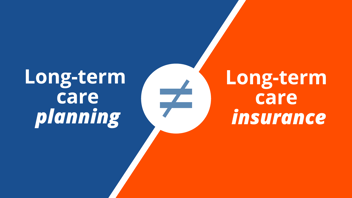
For a long time, advisors have placed long-term care planning into a niche product kind of topic, or excuse me, a niche insurance conversation as opposed to a core planning concept. And honestly, I get it. Historically, long-term care insurance has been fraught with problems.
Traditional long-term care insurance has rate increases, a use-it-or-lose-it nature. Underwriting can be difficult, and it becomes very easy to set it aside and say, “Hey, my clients can self-insure or self-fund.”
But what we’ve seen is a shift in the conversation from pain points and statistics and trying to raise awareness, to pivoting to a much more solution-oriented, proactive approach.
Long-term care planning now is much more about the protection of retirement assets, retaining dignity, independence, and quality of life in retirement, and providing flexibility for families.
And thankfully, the solution set has evolved as well.
We have a litany of new products at our disposal that weren’t available in recent years — be that asset-based solutions, hybrid life insurance, various riders, long-term care, critical illness, chronic illness, annuity-based solutions, short-term care. I mean, the list goes on and on.
We’ve seen a really great evolution in the available products in the space to be able to reach more clients with proactive solutions.
So again, I think the opportunity isn’t found in providing more statistics or more evidence to clients about the need for long-term care. The opportunity is presenting them with a proactive, solution-oriented approach.
Clients aren’t looking for their advisors to solve every risk in retirement. They know that health care is expensive. They know that long-term care is a risk.
What they’re looking for is an advisor that’s willing to engage with them in proper planning before it becomes a crisis.
Q. What current trends are you seeing in long-term care planning?
A. We are seeing the continued rise and dominance of asset-based and hybrid solutions.
Traditional long-term care insurance now only represents about 7% of the total insurance production in the space, which is a surprising statistic for many folks who have been in the business for many years. So we’re seeing the continued growth and dominance of the hybrid or asset-based solutions.
Now, I will say that there’s still definitely a place for traditional long-term care in the market for the right client, but it’s no longer the default solution.
So a tremendous amount of opportunity from a revenue generation standpoint, and as we know, a tremendous amount of need for American retirees.
We’ve also seen an emergence of annuity-based solutions, which I am personally quite bullish on because it’s designed to address a client profile that we may have thought was too old or an inappropriate client profile for long-term care insurance.
Historically, that client profile has shifted much younger, but as we see the silver tsunami peak 65, more and more Americans kind of pass that target profile age. Annuity solutions offer a very compelling solution for those clients.
The benefit being annuities are not priced on age and gender. So even older clients in their late 70s, even up to age 80, can still receive favorable pricing, guaranteed tax-free leverage to protect the rest of their retirement assets.
Additionally, we’re seeing a huge opportunity utilizing 1035 exchanges from existing annuities that clients already have.
One America recently released a survey that was a little surprising to me.
The amount of Americans who point to an in-force annuity contract as their de facto long-term care plan.
Maybe they didn’t think of it when they purchased it, but now when you ask them, “Hey, if you were to need care tomorrow, what’s the first set of assets that we’ll go to?”
And historically, we think, well, our CD or checking or savings account, that money under the mattress, but more and more Americans are pointing to these in-force annuities.
Well, if you’ve had an annuity for many years, whether it’s remained in force or you’ve renewed it a number of times, you potentially have very significant embedded taxation in that contract.
A 1035 exchange allows you to roll that money over tax-free, leverage that pool of money up for long-term care protection.
But because these products are Pension Protection Act qualified, the long-term care benefits also pay out tax-free.
So we’re seeing some really creative solutions, many more types of products to the market, which is expanding the client profile and giving us a much more robust toolkit to address the needs of Americans.
Q. What is the typical client profile for long-term care insurance?
A. So the core client profile remains the same. We’re typically working with folks in their 50s and 60s. Typically, the mass affluent, half a million dollars or more in investable assets. Think standard health. We don’t have to be the healthiest client in the world to secure coverage, but we have to be free of major medical impairments or disqualifications.
But again, as I mentioned in a previous answer, we’ve seen an expansion in that client profile because of the emergence of new products.
Right. So we can now address long-term care planning even younger with extended pay solutions that are still of the hybrid or asset-based variety, meaning that they’re not subject to some of those downsides of traditional long-term care insurance.
So not only do we have multi-pay options where we can pay over a long period of time, but the emergence of those riders allows us to address long-term care planning while we’re addressing a need for permanent life insurance.
That may not be the most efficient, but as I’ve always said to advisors and to clients over the years, the best long-term care plan is the one that you have in force when you need care.
Additionally, we’ve seen that client profile expand on the later age band.
I alluded to this earlier, but the emergence of the annuity-based products that are not priced on age or gender provide much more compelling pricing for somebody in their early, even to late 70s.
Additionally, those annuity products offer very limited, very easy underwriting, which then again expands that client profile to folks that we thought were not healthy enough to secure coverage.
And then we now even have annuity products that offer not true long-term care, but assistance with activities of daily living, some additional leverage for that LTC light type approach — not true long-term care, but still an alternative that might be a good fit for somebody who is just otherwise uninsurable.
So short answer, the client profile remains the same: ages in the 50s and 60s, but now we’ve expanded it on both ends for age, we’ve expanded it for health, and we’ve been able to do some kind of two-in-one type approaches with riders and other types of products.
Q. How can advisors and agents start incorporating long-term care planning into their practice?
A. I think that this really illustrates the importance of finding the right partner to work with.
Here at Senior Market Sales® (SMS), we work with independent insurance agents and financial advisors across the country.
We provide full, robust, IMO-level support for anybody looking to do this themselves, whether that’s from the front end of marketing to your clientele or trying to find new clients through client acquisition strategies, to product evaluation and selection, illustrations, underwriting assistance, everything from prospect to placement, Senior Market Sales can assist.
But what we’ve found is that there’s oftentimes a large gap between my level of competence at my core business and where I would be if I were to add a line of business into my practice.
Senior Market Sales is here to help close that gap.
So this is a great opportunity to introduce our copilot program, really designed to help folks get a head start to accelerate their confidence and their competence to be able to have meaningful conversations for long-term care planning.
We’re providing some point-of-sale assistance where we can help you right at the point of client conversation, and really an approach that emphasizes true partnership to help you maximize the opportunity in front of you and take care of more of your clients.
So if any of our viewers would like to learn a little bit more about that program, please reach out to anybody here at Senior Market Sales, and I would love to have a conversation in more detail.
Explore Long-Term Care Planning Support From SMS
Share this blog post:

Survey Reveals Americans Feel Unprepared for...
Americans overwhelmingly agree (96%) that planning for long-term care (LTC) is important, but only 19% have actually started planning for it,...

Are You Dropping the Ball With Long-Term...
The need for long-term care (LTC) planning in the United States is enormous, and that means the opportunity for retirement planning professionals to...