
 Log In
Long-term care (LTC) planning can feel like a difficult addition to a practice. You may not sell insurance, feel ready to discuss care costs or have time to create the materials needed to educate clients and prospects. But you don’t have to be an expert overnight or build everything yourself.
Here are eight common obstacles financial advisors and insurance agents face when helping clients prepare for the financial impact of long-term care — and the resources to help you overcome them.
1. How Can I Offer Long-Term Care Planning If Insurance Isn’t My Core Business?
The long-term care needs of an aging population have driven the development of new partnerships, solutions and services beyond traditional long-term care insurance and the agents selling it.
 With more options today, you can decide how to provide LTC planning: develop the capability internally, expand with specialist support or refer clients to a trusted partner.
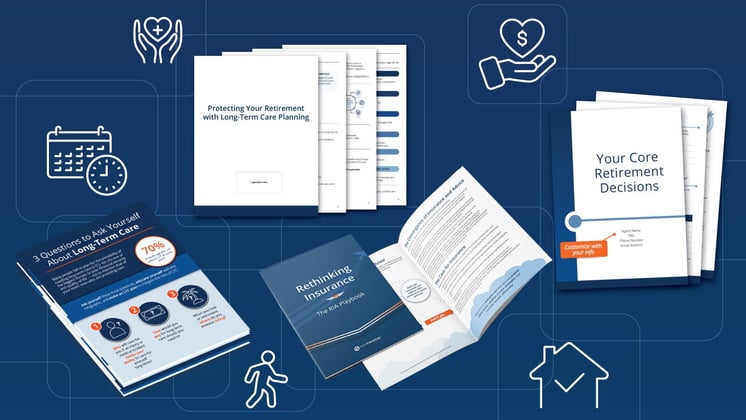
Senior Market Sales® (SMS) maps out your options through the SMS Financial Solutions’ resource: The RIA Playbook: How Advisors Win More Wallet Share Through Holistic Planning. This playbook outlines practical paths for registered investment advisors (RIAs) and investment advisor representatives (IARs) to add long-term care financial planning, as well as other insurance needs, to your practice — whether you’re hands-on, hands-off or somewhere in between. Just choose a model that fits your business.
2. How Do I Start the Long-Term Care Conversation With Clients?
Begin with the client’s retirement goals, not a product. One effective way to bring up the topic is by presenting prospects or clients with an educational retirement guide that explains the cost of long-term care and debunks the myth that Medicare pays for LTC.
SMS offers several options:
- “Protecting Your Retirement With Long-Term Care Planning” — a customizable consumer-facing guide that gives you a focused way to introduce LTC planning, asset protection and family considerations.
 “3 Questions to Ask Yourself About Long-Term Care” — a customizable infographic that educates prospects and clients on the need for LTC planning but also guides them to reflect with three questions:
- Who will care for you if an injury, illness, medical incident or aging limits your ability to care for yourself long-term?
- How would you pay for long-term care should you need it?
- When you look at retirement, where do you envision living?
- “Your Core Retirement Decisions” — a customizable guide that helps clients see where long-term care fits in the larger retirement picture and that includes a retirement timeline of important decisions, including when to consider LTC insurance.
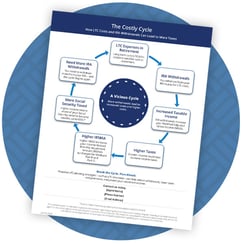 “The Costly Cycle: How LTC Costs and IRA Withdrawals Can Lead to More Taxes” — a customizable flyer that educates prospects and clients about the additional taxes. Read the blog “How Long-Term Care Expenses Can Trigger a Tax Spiral in Retirement” to learn more.
All of the client-facing materials are available in the Client Stream® Marketing Library and require a MySMS account — just log in or register.
Whether you use a specific LTC-focused guide or a broader retirement planning guide, keep the LTC discussion grounded in the client’s desired independence and care preferences. If Medicare comes up, explain that Medicare may cover limited medically necessary services, but it generally does not cover ongoing custodial long-term care. This is a particularly powerful point — when people understand the gap in coverage, they naturally want to find solutions to finance the true costs of LTC.
3. How Do I Help Clients Understand Their Long-Term Care Planning Options?
Long-term care planning is a process, not a synonym for long-term care insurance. Insurance can be one solution, but the planning should come first. That discussion should include how a client wants to receive care, who may provide it, which assets they want to protect and how they want to preserve flexibility for a spouse or family.
The same client-facing resources that helped you open the LTC planning conversation with clients can help them understand their options: “Protecting Your Retirement With Long-Term Care Planning,” “3 Questions to Ask Yourself About Long-Term Care” and “Your Core Retirement Decisions.”
4. How Can I Find a Solution for a Client Who Does Not Fit Traditional LTC Insurance?
Traditional long-term care insurance can be a strong fit for some clients, but it is not the only approach. Age, health, liquidity, existing coverage, legacy goals and willingness to pay can all affect which strategy merits consideration. Today’s planning landscape may include traditional LTC insurance, life insurance with long-term care benefits, asset-based or linked-benefit solutions, annuity-based approaches and other strategies.
Read this blog, “How Should Advisors Match Long-Term Care Solutions to Different Client Profiles?”, to gain a better understanding of how today’s expanded menu of solutions could fit your similar client situations.
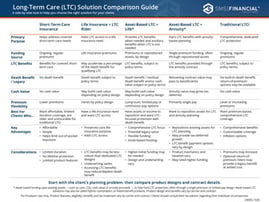 For an at-a-glance reference to help you sort through the solutions, use the free “Long-Term Care (LTC) Solution Comparison Guide.”
Avoid trying to force every client into a product category. Use informal underwriting or case review early to narrow the options before a formal application. SMS can help you evaluate the client situation and access the appropriate carrier resources.
To learn more about how the available solutions have evolved beyond a product-first discussion, watch “How Can I Incorporate Long-Term Care Planning Into My Business?”
5. How Can I Help a Client Use an Existing Annuity for Long-Term Care Planning?
An existing annuity is not automatically a long-term care solution. But when a client expects that annuity to help cover future care costs, its gains may create a planning opportunity. Depending on the contract, tax situation and goals, there may be a more tax-efficient way to position funds for long-term care. That analysis requires case-specific guidance and should be coordinated with the client’s tax professional.
Read the blog, “Help Clients Fund Long-Term Care and Save Taxes at the Same Time: LTC Annuity Hybrids,” to learn how to turn an annuity’s deferred gains into tax-free LTC benefits for clients.
Watch the on-demand webinar, “Surprising Ways to Fund Long-Term Care to Protect Clients’ Assets (and Your AUM),” to explore how new hybrid policies link LTC insurance to annuities and life insurance.
6. How Can I Market Long-Term Care Planning When I Don’t Have Time to Create My Own Materials?
 You do not have to create every client handout, email or presentation from scratch to bring long-term care planning to more clients and prospects. SMS’ Client Stream Marketing Library provides customizable marketing content and turnkey workshop programs that can help you educate clients, build your brand and convert leads into appointments.
In addition to the consumer-facing long-term care planning guide and retirement decisions guide, the marketing library includes an LTC Awareness Month email you can send to clients and prospects in November, a flyer showing businesses how LTC insurance premiums may be tax deductible, and all the materials you need to promote and execute an educational LTC workshop, including an entire email drip campaign.
Accessing the marketing library requires a MySMS account — just log in or register.
7. How Can I Build Confidence Before Discussing Long-Term Care Solutions?
Learn the planning problem, know the questions to ask, and understand when to bring in support.
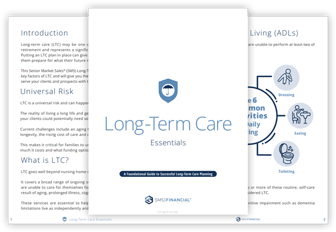 SMS has an agent- and advisor-facing guide and an entire training series dedicated to building your LTC planning confidence, as well as the LTC planning experts to support you as you work with clients.
The free downloadable “Long-Term Care Essentials: A Foundational Guide to Success” is an agent- and advisor-facing guide to help you learn the basics, and free, on-demand courses let you watch on your schedule, at your convenience. The courses include:
- Intro to Long-Term Care
- Levels of Care
- Care Settings
- Understanding the Risk: Cost and Duration of Care
- Impact on Caregivers
- Paying for Long-Term Care
- Cost of Waiting
- Tax Incentives
Both the guide and the training series are available in the MySMS Learning Academy, which requires a MySMS account.
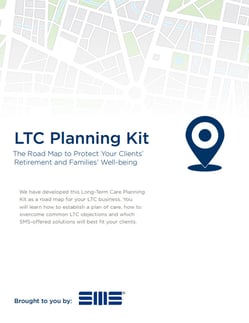 The free LTC Planning Kit also can help build your confidence, with how to establish a plan of care, how to overcome common LTC objections and printable worksheets to use on appointments. Download it here.
If you’re just starting to consider LTC planning, read “Long-Term Care in Retirement Planning: What Financial Advisors and Insurance Agents Need to Know.”
Want an even higher-level view? To understand how LTC planning fits within retirement planning, download the free SMS white paper, “The Retirement Planning Mind Shift: New Thinking for Growth in a New Era.”
8. Where Can I Get Help With a Long-Term Care Case?
Long-term care planning does not have to be a solo effort. When a case involves complex health history, an existing annuity, product comparisons or an unfamiliar client profile, bring in an LTC specialist early. The right support can help you identify viable paths, avoid unnecessary applications and keep the planning conversation moving.
You can remain the client’s trusted advisor while working with specialists who help evaluate solutions, navigate carrier requirements and support the case from initial conversation through placement. The SMS Financial Solutions team can support you every step.
Whether you are reviewing a traditional LTC case, a life/LTC hybrid or an existing annuity, SMS can help you with products, underwriting and case-design support. Call SMS at 1.888.456.8884, or fill out this form for a marketing consultant to reach you.
Overcome LTC Planning Obstacles With SMS Financial Solutions Support
SMS understands the obstacles and is dedicated to delivering resources to help you overcome them. If you need help with a long-term care case or want to explore how SMS can support your practice, let’s talk.
Share this blog post:


